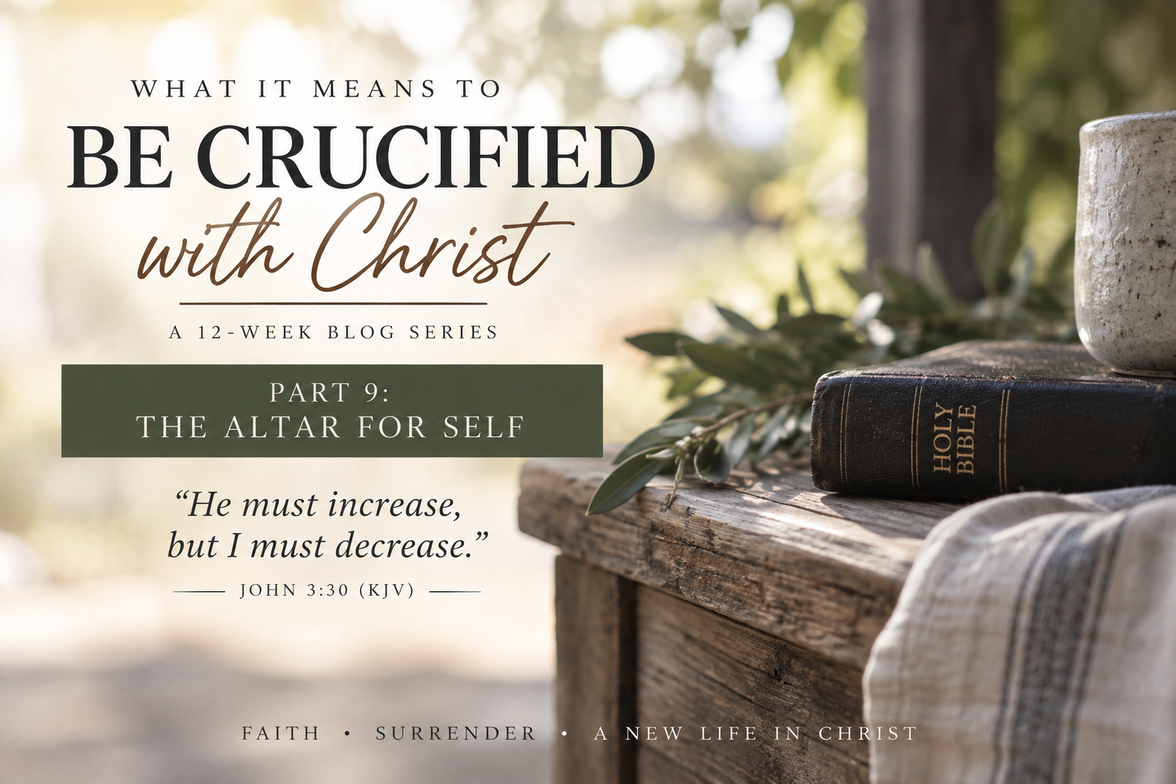
What It Means to Be Crucified with Christ

Hi friends,
When we think about an altar, we usually think about sacrifice.
Something is placed there.
Something is surrendered.
Something is given over completely.
And that is exactly why the Cross is such a powerful picture for the Christian life.
Most of us understand the Cross as the place of salvation.
But it is also the place where self is laid down.
The Cross is not only about forgiveness.
It is about freedom from the power of sin through daily surrender.
What is still trying to rule?
Romans 6:6 reminds us that our old self was crucified with Christ so that we would no longer live as slaves to sin.
That sounds settled.
And spiritually, it is.
But practically, we still face moments when self wants to take the throne again.
Self says:
“I know what is best.”
“I need to stay in control.”
“I cannot let this go.”
“I need their approval.”
“I have to protect myself.”
That is why dying to self is not a one-time decision.
It is a daily choice.
Pressure reveals what is still alive
One of the most uncomfortable truths in this lesson is that pressure often reveals what still needs to die.
The lesson points back to Judges 3:1–4, where Israel still had enemies in the land that tested their obedience. In the same way, God may allow circumstances to reveal where self is still active in us.
That can be humbling.
We may think we are patient until someone pushes us.
We may think we trust God until a situation feels out of control.
We may think we have forgiven until the wound is touched again.
Pressure does not always create the problem.
Sometimes it exposes it.
And exposure can be mercy, because God cannot heal what we insist on hiding.
The sins that do not always look like sins
We usually think of surrender in terms of obvious wrongdoing.
But the lesson names some quieter things that can still rule the heart:
-
pride,
-
self-reliance,
-
the need for control,
-
people-pleasing,
-
bitterness,
-
self-protection.
Those can be much harder to recognize because they often feel justified.
Control can feel like responsibility.
People-pleasing can look like kindness.
Self-protection can look like wisdom.
Self-reliance can look like strength.
But if they keep us from depending fully on Christ, they still belong on the altar.
Stay on the altar
One of the most striking images in this lesson comes from Psalm 118:27:
“Bind the sacrifice with cords, even unto the horns of the altar.”
The lesson explains that sacrifices were bound so they would stay in place.
That gives us such a practical picture of surrender.
Sometimes we lay something down…
and then pick it right back up.
We surrender control in prayer, then spend the rest of the day trying to manage every outcome.
We give God our fear, then return to rehearsing every worst-case scenario.
We say we forgive, then revisit the offense again and again.
Surrender is not passive.
Sometimes surrender means choosing, again and again, to leave something where we placed it.
He must increase
John 3:30 (KJV) says:
“He must increase, but I must decrease.”
That does not mean we become less valuable.
It means Christ becomes more visible.
Less of my pride.
More of His humility.
Less of my control.
More of His lordship.
Less of my self-reliance.
More dependence on Him.
Less of my way.
More of His.
The goal of the crucified life is not behavior modification.
It is identity transformation.
Christ becoming more evident in us.
Surrender can hurt
The lesson also points us to Philippians 3:10, where Paul speaks about knowing Christ through the fellowship of His sufferings and being made conformable unto His death.
Sometimes dying to self feels like loss.
It may mean letting go of:
an ambition,
a preference,
comfort,
recognition,
being understood,
or getting our way.
And that can hurt.
But with Christ, surrender is never empty.
Resurrection life flows from the Cross.
The Cross is our altar too
The Cross was Jesus’ altar of obedience.
And in a very real sense, it becomes ours too.
Not because we are trying to earn salvation.
But because those who belong to Christ are called to live surrendered lives.
Galatians 5:24 (KJV) says:
“And they that are Christ’s have crucified the flesh with the affections and lusts.”
That is the daily call.
To lay down pride.
Fear.
Control.
Bitterness.
Unforgiveness.
Self-protection.
Anything that keeps Christ from fully ruling the heart.
Reflection
Take a quiet moment today and ask yourself:
-
What part of me still wants to stay in control?
-
What has pressure revealed in my heart lately?
-
Is there something I keep placing on the altar and then picking back up?
-
Where is God asking me to decrease so Christ can increase?
A Word of Encouragement
Friend, surrender is not God taking something good away from you.
It is God freeing you from what keeps you bound.
The altar is not a place of defeat.
It is a place of freedom.
And every time we choose to lay self down, we make more room for Christ to be seen in us.
“He must increase, but I must decrease.” — John 3:30 (KJV)
This is Part 9 of our 12-week series, What It Means to Be Crucified with Christ. Join us next week for Part 10: The Cross in Experience.